
What Districts Really Look For When Buying AI Tools
(and What They Wish They Could Look For)
Zia Hassan (JHU)
Definitions
K-12 AI Tools
Educational technology tools that market themselves as AI-enabled
Efficacy Evidence
Data or findings from a study showing whether a tool improves student learning outcomes
Study Overview
- K–12 districts are adopting AI-enabled EdTech faster than researchers can establish evidence of efficacy
- This study examines what signals districts rely on when procuring AI tools, and how much weight efficacy evidence carries relative to those signals
Methods
- 5 semi-structured interviews across different K–12 districts, paired with a review of the literature on AI-enabled EdTech procurement and evidence of efficacy
- Thematic coding of interviews
- Analysis of interviews to support or contradict literature
The Headline Finding
- Districts lean on practical, available signals while evidence of AI tools' efficacy catches up
- Two signals act as thresholds a tool must clear before efficacy is even discussed
- Two more act as proxies, standing in for efficacy evidence that isn't readily available
- All five interviewees said efficacy evidence matters — but none raised it first
Threshold Signals
- Functional validation – "does it work as intended?"
- Interoperability – "does it connect to our systems?"
- A tool that fails either test is disqualified, regardless of any other evidence
"We'll start playing with importing information in, seeing what it looks like on the student side… and putting in things to see what the generated result's going to be."
"It had to go through Canvas… to make sure everything would be matching."
Proxy Signals
- Peer adoption – "what are similar, trusted districts using?"
- User delight – "was it enjoyable to use?"
- Both are within a district's control and immediately available — unlike efficacy evidence
"A salesman's gonna tell you what you wanna hear... to sell the product. But if you hear it from a source that says, hey, this is really good... you can trust that as a valid source."
"If the students like it, that's good enough for our teachers, and our teachers will advocate on their behalf."
Why the Gap Exists: Evidence Is Still Scarce
- Of 800+ papers on AI in K–12, only 20 met the bar for strong causal evidence (Fesler et al., 2026)
- None of the student-facing causal studies took place in U.S. K–12 schools; most research is postsecondary; effect is mitigated when compared with non-AI interventions (Létourneau et al. 2025)
- No research yet examines impacts for students with IEPs or 504 plans
What Evidence Do We Have?
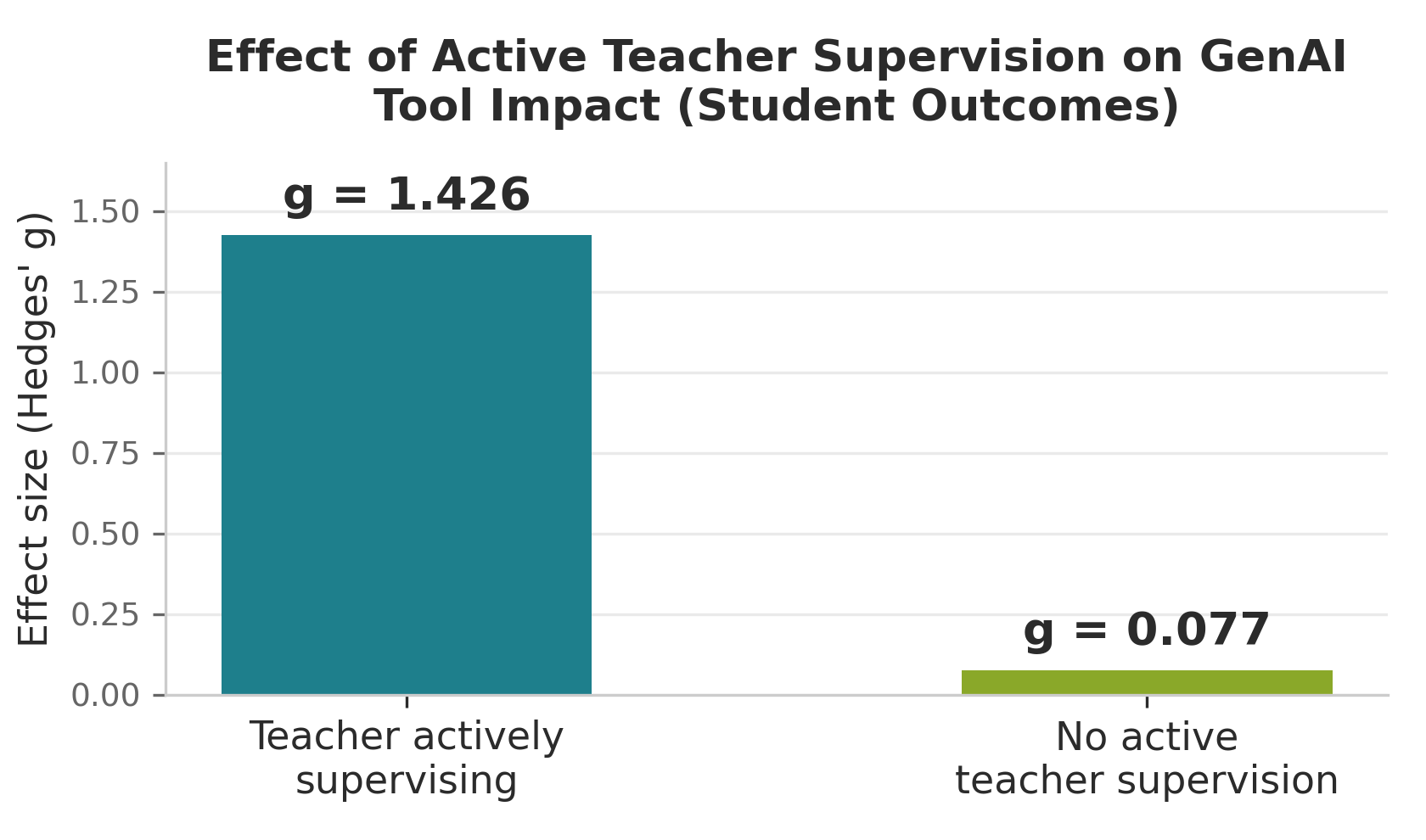
- With teacher support during students' GenAI use: large effect (g = 1.43). Without it: essentially none (g = 0.08) (Gu et al., 2025)
- But how does AI + teacher compare to the same teacher support without AI? We don't know yet.
What Evidence Do We Have?
- After correcting for publication bias, the overall effect of GenAI on STEM learning drops to near zero (Boolzen et al., 2026)
- 33 of 59 comparisons pitted an interactive AI activity against a passive control (e.g., watching a lecture video)
Why the Gap Exists: Vendor Evidence Isn't Trusted (Morrison et al., 2014)
- Fewer than half of district respondents in prior research trusted vendor-submitted evidence
- Interviewees described vendor claims as unverifiable on their face
- Functions more as institutional cover than as a real decision driver
"Yeah, your Sharpie can do that… show me the real stuff."
Why the Gap Exists: Peer Choices & Limited Frameworks
- Districts substitute peer behavior for their own efficacy evaluation, AKA institutional isomorphism (DiMaggio & Powell, 1983)
- Existing frameworks (EdSafe, ISTE, CoSN) are used inconsistently
- AI tools are adopted before they can really be evaluated
How the Signals Connect
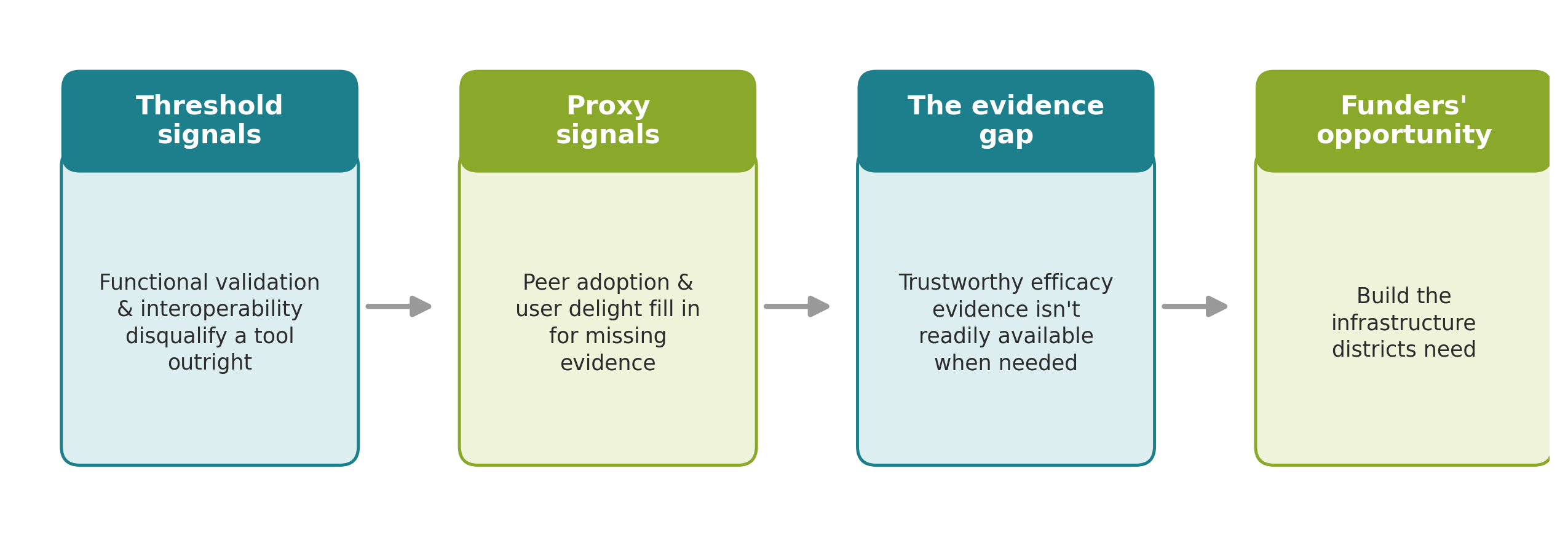
Recommendations to move toward evidence of efficacy
- A shared, pre-vetted evidence repository
- Replication studies in underrepresented districts
- More studies that compare non-AI teacher interventions to AI interventions with teacher supervision
- A standardized, rapid-pilot protocol
Recommendations for threshold markers (based on interview data)
- Developing a common certification effort for interoperability (works with Canvas/Google/Blackboard)
- Capacity-building for small & rural districts. Seed shared regional evaluation capacity.
- An online forum or place for exchange about what has worked at various schools
Appendix Matrix: Impact vs. District Burden
| Recommendation | Impact | District Cost/Burden | Cultural Shift | Time to Benefit |
|---|---|---|---|---|
| Shared evidence repository | Every district gets a tiered, efficacy-verified tool list | Low–Medium | Moderate — trusting an external rating over peer/vendor signals | Slow — value accumulates over time |
| Replication studies | Tests whether findings generalize to underrepresented populations | Moderate–High | Low–Moderate | Slow — 1–3 years to design, run, publish |
| Standardized rapid-pilot protocol | Streamlines something districts already do inconsistently | Low–Moderate | Low — doesn't change what districts do, just how rigorously they document it | Fast — no new infrastructure required first |
Appendix Matrix: Evidence Basis
| Recommendation | Key Evidence |
|---|---|
| Shared evidence repository | Peer adoption is already the dominant signal (DiMaggio & Powell, 1983); Digital Promise's League of Innovative Schools shows districts adopt ESSA-tier certifications |
| Replication studies | K-12 meta-analyses (Yi et al., 2025; Wu et al., 2026) code grade level, sample size, design — but not SES, Title I, or IEP/disability status |
| Standardized rapid-pilot protocol | Districts pilot inconsistently, nearly half view teacher-led pilots as a "nuisance" (Adams-Bass et al., 2015); small/rural districts lack dedicated evaluation staff (Bacak et al., 2023) |
Contact
zhassan4@jh.edu
linkedin.com/s/zia-s-hassan
Slides available at ziahassan.com/sree2026
References
Adams-Bass, V., Atchison, D., & Moore, L. (2015). Pilot-to-purchase project. UC Davis School of Education.
Bacak, J., Wagner, J., Martin, F., Byker, E., Wang, W., & Ahlgrim-Delzell, L. (2023). Examining technologies used in K-12 school districts: A proposed framework for classifying educational technologies. Journal of Educational Technology Systems. https://doi.org/10.1177/00472395231155605
Boolzen, C., Kuhn, J., Flegr, S., Rott, E.-M., Stausberg, N., & Küchemann, S. (2026). Evidence of impact and interpretational limits of generative AI in STEM education: A systematic review and meta-analysis on cognitive learning outcomes. Artificial Intelligence Review.
DiMaggio, P. J., & Powell, W. W. (1983). The iron cage revisited: Institutional isomorphism and collective rationality in organizational fields. American Sociological Review, 48(2), 147.
Fesler, L., Martinez Claeys, J. P., Agnew, C., & Loeb, S. (2026). The evidence base on AI in K-12: A 2026 review. Stanford SCALE Initiative.
Gu, J., & Yan, Z. (2025). Effects of GenAI interventions on student academic performance: A meta-analysis. Journal of Educational Computing Research, 63(6), 1460–1492.
Létourneau, A., Deslandes Martineau, M., Charland, P., Karran, J. A., Boasen, J., & Léger, P. M. (2025). A systematic review of AI-driven intelligent tutoring systems (ITS) in K-12 education. npj Science of Learning, 10, 29.
Lue, G. (2026, January 16). Blueprints for better AI in education: Insights from the K-12 infrastructure program. Digital Promise.
Morrison, J. R., Ross, S. M., & Corcoran, R. P. (2014). Fostering market efficiency in K-12 ed-tech procurement.
Wu, X., Zhu, P., Zhang, J., Yin, M., & Wang, Y. (2026). ChatGPT's impact on student learning outcomes: A meta-analysis of 35 experimental studies. Humanities and Social Sciences Communications, 13(1), 684.
Yi, L., Liu, D., Jiang, T., & Xian, Y. (2025). The effectiveness of AI on K-12 students' mathematics learning: A systematic review and meta-analysis. International Journal of Science and Mathematics Education, 23(4), 1105–1126.